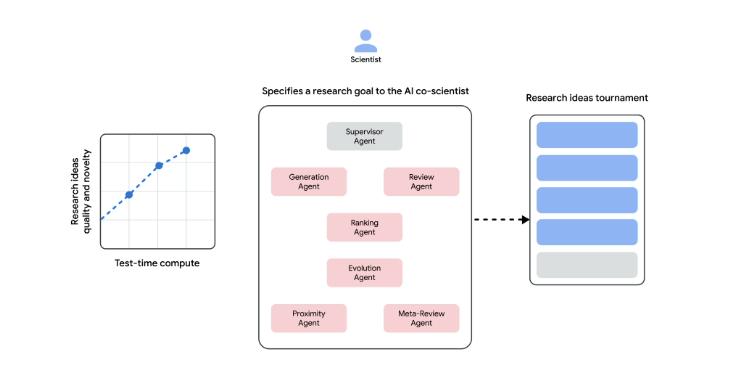
Google has introduced a groundbreaking AI tool designed to assist biomedical researchers in their work. This virtual collaborator helps scientists process vast amounts of information and even generate fresh hypotheses, potentially accelerating discoveries in medicine and science.
The tool has already been tested by experts at Stanford University and Imperial College London, demonstrating its ability to enhance scientific research through advanced reasoning.
AI’s Expanding Role in the Workplace
Artificial intelligence is increasingly becoming a key player in workplaces across industries. From answering customer service calls to conducting legal research, AI has proven its value. Following the success of models like ChatGPT, Google’s latest AI innovation aims to revolutionize scientific collaboration.
DeepMind, Google’s AI division, has made science one of its top priorities. The unit’s head, Demis Hassabis, even shared a Nobel Prize in Chemistry last year for technology developed at DeepMind.
Promising Results in Liver Disease Research
In a recent experiment focused on liver fibrosis, Google’s AI co-scientist provided potential solutions that showed strong promise in inhibiting disease progression. According to Google, the AI system not only suggested valuable approaches but also improved solutions over time.
While these findings are still preliminary and require further validation, they indicate that AI can effectively enhance the work of expert scientists.
AI to Complement, Not Replace, Scientists
Despite its capabilities, the AI tool is designed to support rather than replace human researchers. According to Vivek Natarajan, a scientist at Google, AI will enhance scientific collaboration rather than diminish it.
As AI technology continues to advance, tools like Google’s AI co-scientist could play a significant role in accelerating discoveries and innovations across various fields.
With AI playing an ever-growing role in research, the future of scientific discovery looks brighter than ever. What are your thoughts on AI’s role in the lab? Let us know!